It’s early March, and the Old Forest is turning green. The first velvety pawpaw flowers are emerging, and cellophane bees are digging their nests among the huge tree roots alongside East Parkway Pavilion. All this activity means that Bill Bullock’s volunteer invasive removal crew is out for one last expedition, celebrating another winter of creating a healthier forest.
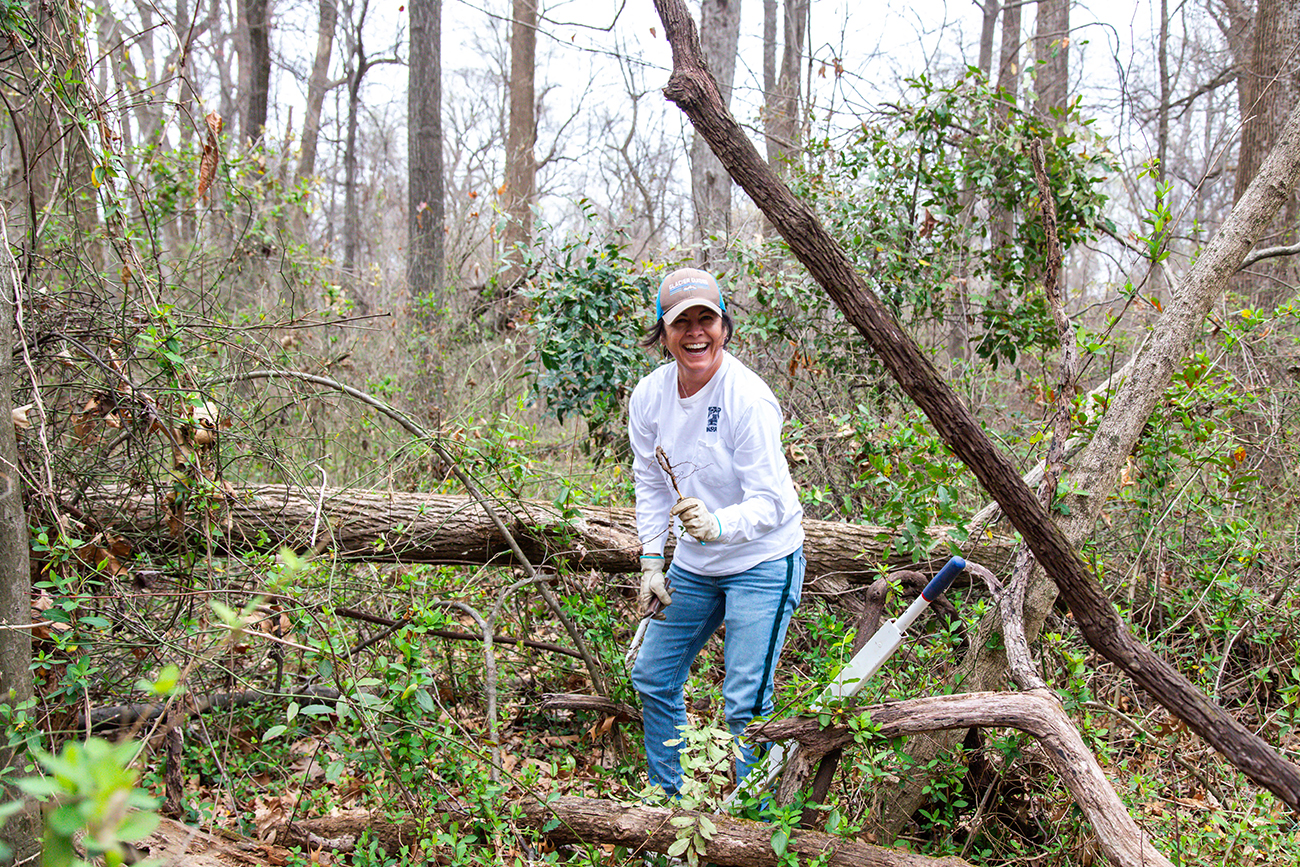
Today, Bill’s crew of regulars is joined by a first-time volunteer, so Bill shows her the ropes. “We’re mostly focusing on large woody plants like Chinese privet and cherry laurel this time of year,” he explains. “In the winter, non-native plants tend to be the only ones with green leaves, so they’re highly visible and we can spot and remove them easily. We want to get to them before they produce berries and distribute seeds.”
He points out a Chinese privet plant that’s about two feet high, with small bright green leaves. After working it out of the soil, he hangs it upside-down by the roots on a nearby tree. “There are three reasons we do this,” he says. “One, so their roots don’t have contact with the ground, which would allow them to resprout. Two, so we know where we’ve been. And three, so the little privets know we’re onto them.”
After discovering that around 100 of the Old Forest’s 350+ flowering plants were non-native, Bill decided to learn everything he could about the best way to remove the most damaging invasives—and how to prevent the cycle of non-native plants making their way into natural areas from home gardens. He started volunteering with Overton Park Conservancy to complete training in selective herbicide application and manual removal. In 2019, he began recruiting volunteers—affectionately known as the Invasive Avengers—and they’ve been working ever since.
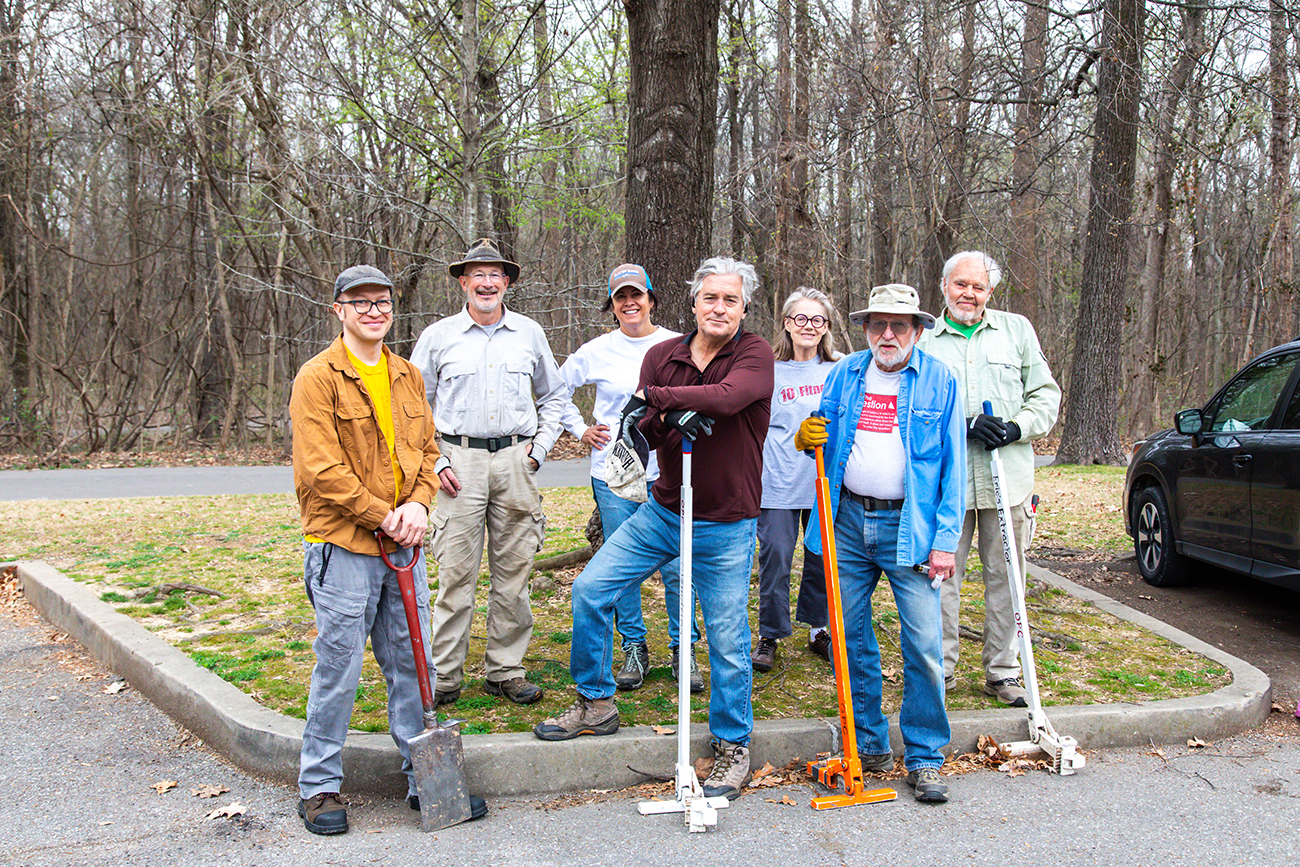
Bill’s crew meets every Friday during the winter months, when native wildflowers are lying dormant under the soil and won’t be trampled by the volunteers’ boots. He also hosts larger weekend workdays that attract college students who get an ecology lesson along with a day of hard work.
Victoria Van Cleef runs in Overton Park several times a week, and one morning she saw the sign Bill puts out during every workday that encourages folks to stop and ask the volunteers what they’re up to. She did, and wound up attending first a Saturday workday and then the regular Friday events. She estimates that she removes more than 50 plants each day, and thousands over the course of the winter. “You can really see the difference—it opens up the forest in a beautiful way,” allowing sunlight to reach the forest floor and giving the next generation of native plants a chance to grow.
With ten years under his belt, Bill is seeing the progress in real time. “There are very few large woody invasives now,” he says. “My hope is that since we have vastly decreased the number of seed-bearing invasives, the pace at which the new invasive plants pop up is slowing down.”
With the space created by the removal of these plants comes an opportunity to kickstart the growth of natives, particularly in areas like the one just inside the gateway that leads from the dog park into the forest. This area had been covered with invasive paper mulberry trees that were removed last summer. Working under the Conservancy’s supervision, Bill broadcast seed pods he’d collected from Eastern redbud trees in this area.
When the Conservancy’s Director of Operations, Dr. Eric Bridges, found through his research that white oak acorns in the forest were having trouble growing into young trees due to seed predation, Bill began collecting acorns from the forest and germinating them at home. Over the past two autumns, he’s planted thousands of white oak seedlings in the canopy gaps, where they’ll have plenty of access to sunlight that will help them grow quickly.
Even if you’re not able to join the regular work in the forest, there’s still plenty you can do to help out. Bill is particularly passionate about educating homeowners that what they plant in their yards matters to places like the Old Forest. Cherry laurel, a small ornamental tree not native to our region, was not recorded in the 1987 inventory of the Old Forest conducted by Dr. James Guldin. But over the past few decades its seeds escaped from neighborhood plantings and it became abundant in the forest, taking up space, sunlight, and nutrients needed by the plants of our local ecosystem. Likewise, Japanese honeysuckle and English ivy cover areas of the forest floor and wrap around trees, while providing little to no nutritional value to our native insects. Refraining from planting these at home reduces seeds being spread into areas like the forest, where they can do a lot of damage in a short time.
“The forest has been invaded by what we’ve planted at home for 100 years,” Bill says, handing his new volunteer a pair of gloves. “But what we’re doing out here is giving oaks a fighting chance.” With that, they disappear into the woods, ready to show some little privets who’s boss.