words and photos by Melissa McMasters
A few weeks ago, in between rain showers, our Stewardship Manager Fields Falcone polled the office to see if anyone wanted to go out and look for mushrooms. The damp conditions were ripe for spotting fungi, since moisture helps their spores to spread. I don’t need much convincing to take a quick nature outing, so within a few minutes we were in the Old Forest, curious to see what we’d find.
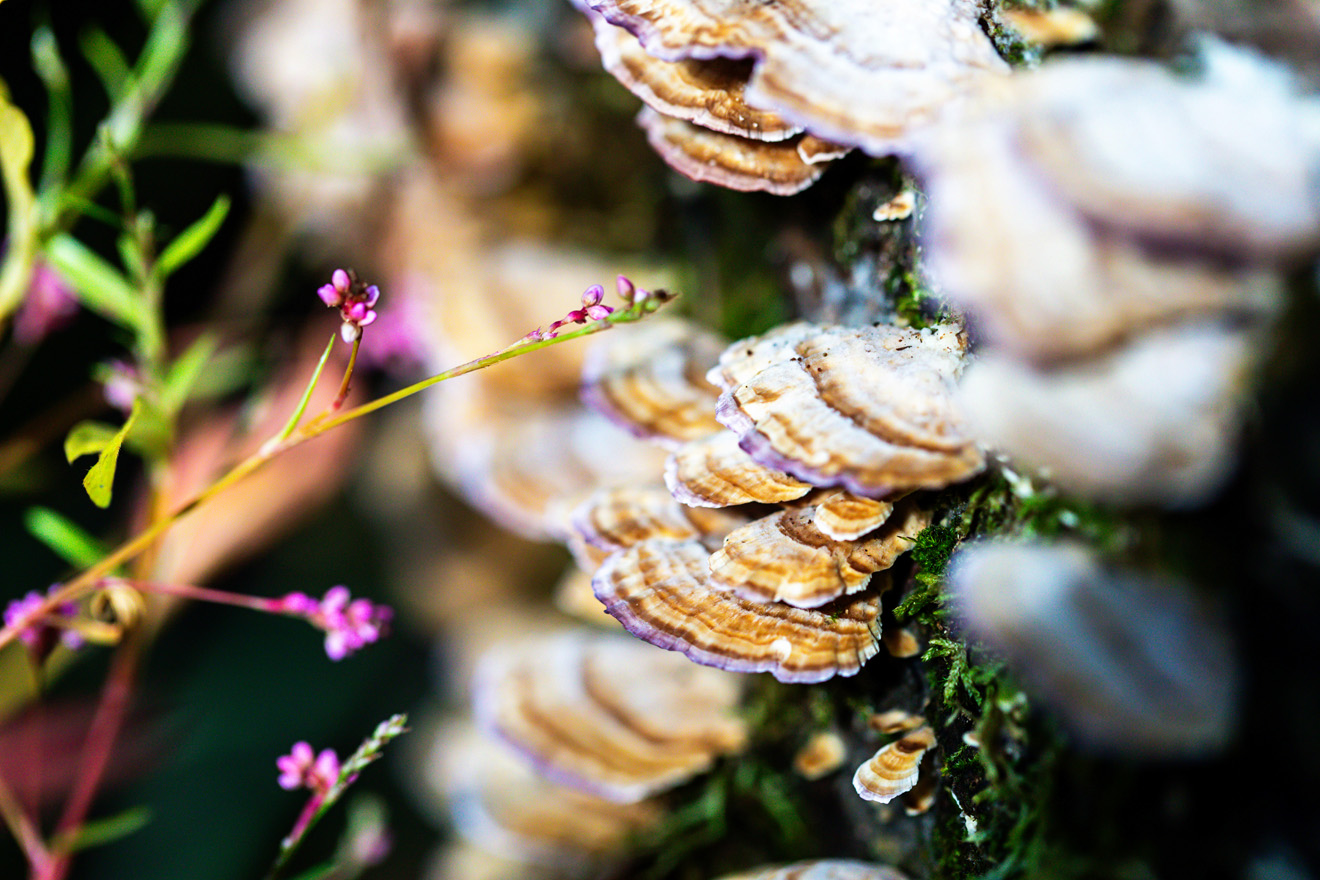
First up: one of the most common mushrooms in a hardwood forest, the turkey-tail (Trametes versicolor). While this mushroom has many lookalikes, genuine turkey-tails have bands of color that are also often bands of texture–they alternate between fuzzy and smooth. We gently shook hands with these to feel how sturdy they were.

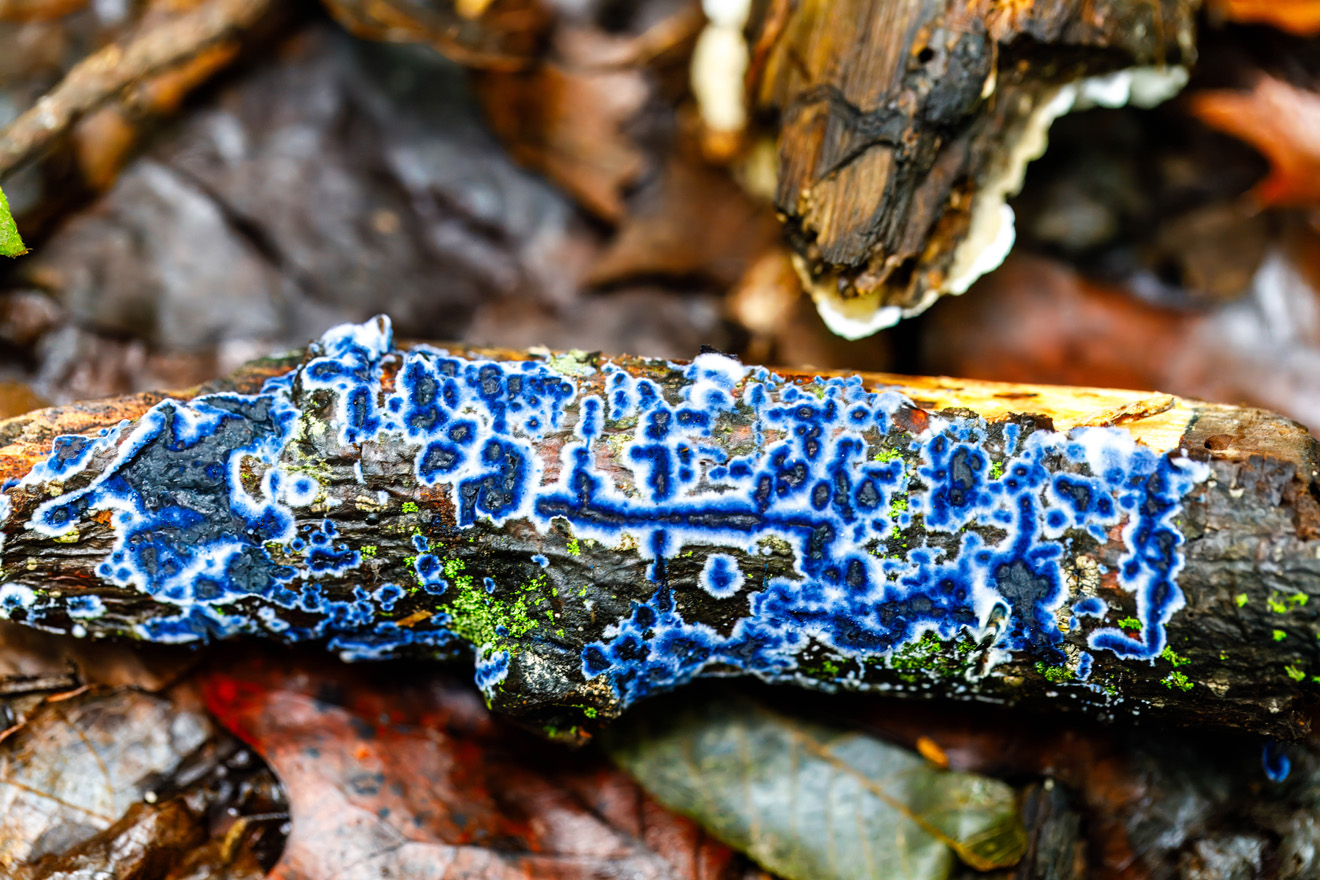
As we rounded our first corner, we caught a glimpse of something bright blue. We assumed it was a snack wrapper or a discarded toy, because that shade had to be too beautiful to occur naturally. But a closer look revealed that it was a holy grail–a fresh cobalt crust (Terana coerulea) growing on a piece of a fallen branch. Fields and I have been known to finish each other’s nature-related sentences, or at least speak the same words in unison, and that’s what happened here with our expressions of unprintable glee. Often, observations of cobalt crust happen when the specimens are older and have turned dark blue or black, so seeing one in full Memphis Tiger blue felt like winning the fungus lottery.
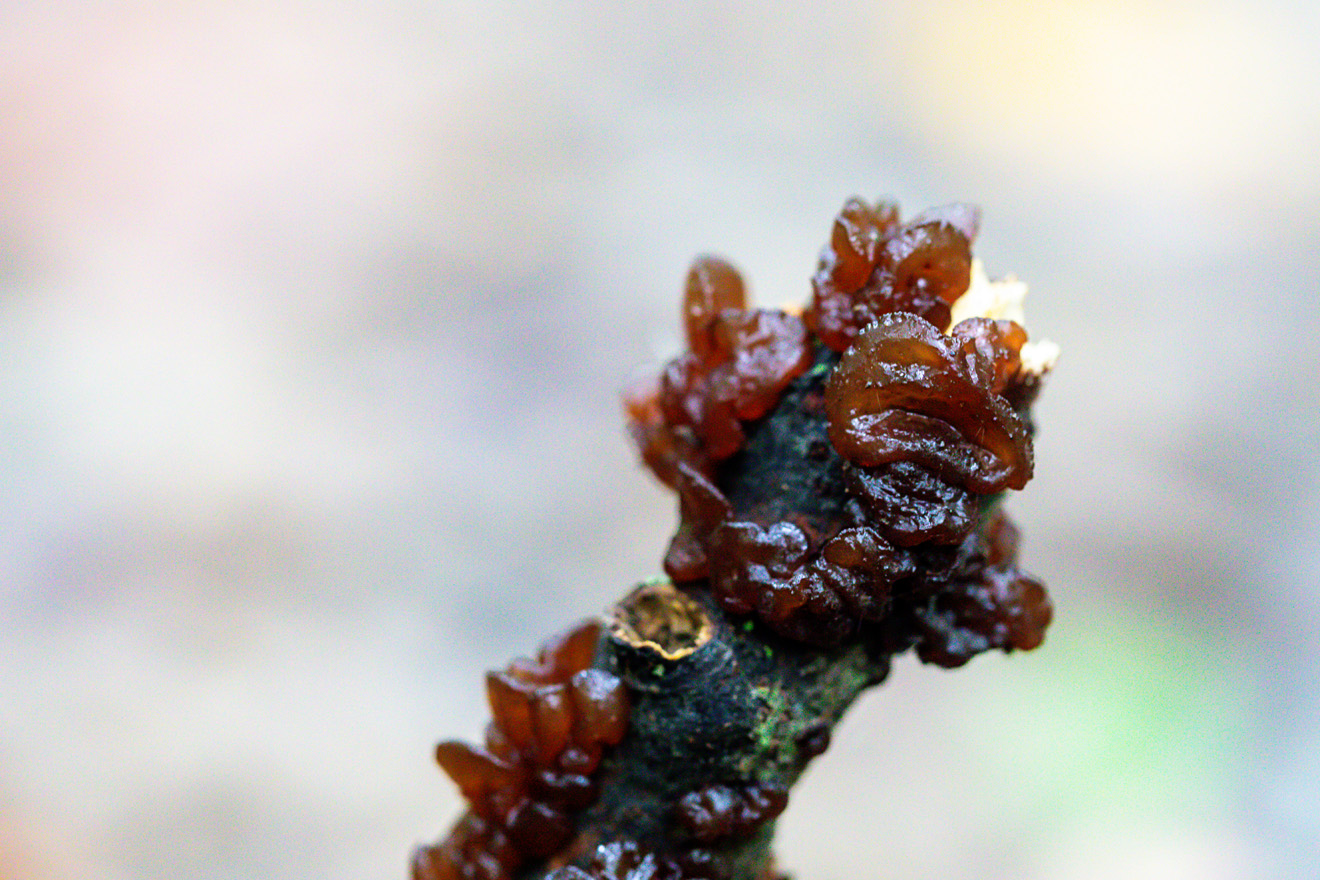
Fresh from this triumph, we stooped down to check out an American amber jelly fungus (Exidia crenata). The fruiting bodies of jelly fungi are so named for obvious aesthetic reasons, but in reality their texture is often quite firm. They can shrivel up in dry weather but plump right back up after a rain, like if a raisin were able to turn back into a juicy grape.
Next we turned left onto the wildflower trail, where in the spring the wood poppies form a yellow blanket as far as the eye can see. There’s a big downed tree on the left side of the trail that makes a good perch from which to observe those flowers, but this time of year it’s filled with interesting pockets of mushrooms. These bonnets (Mycena sp.) were no more than a few centimeters in diameter, and looked like delicate pink bells.

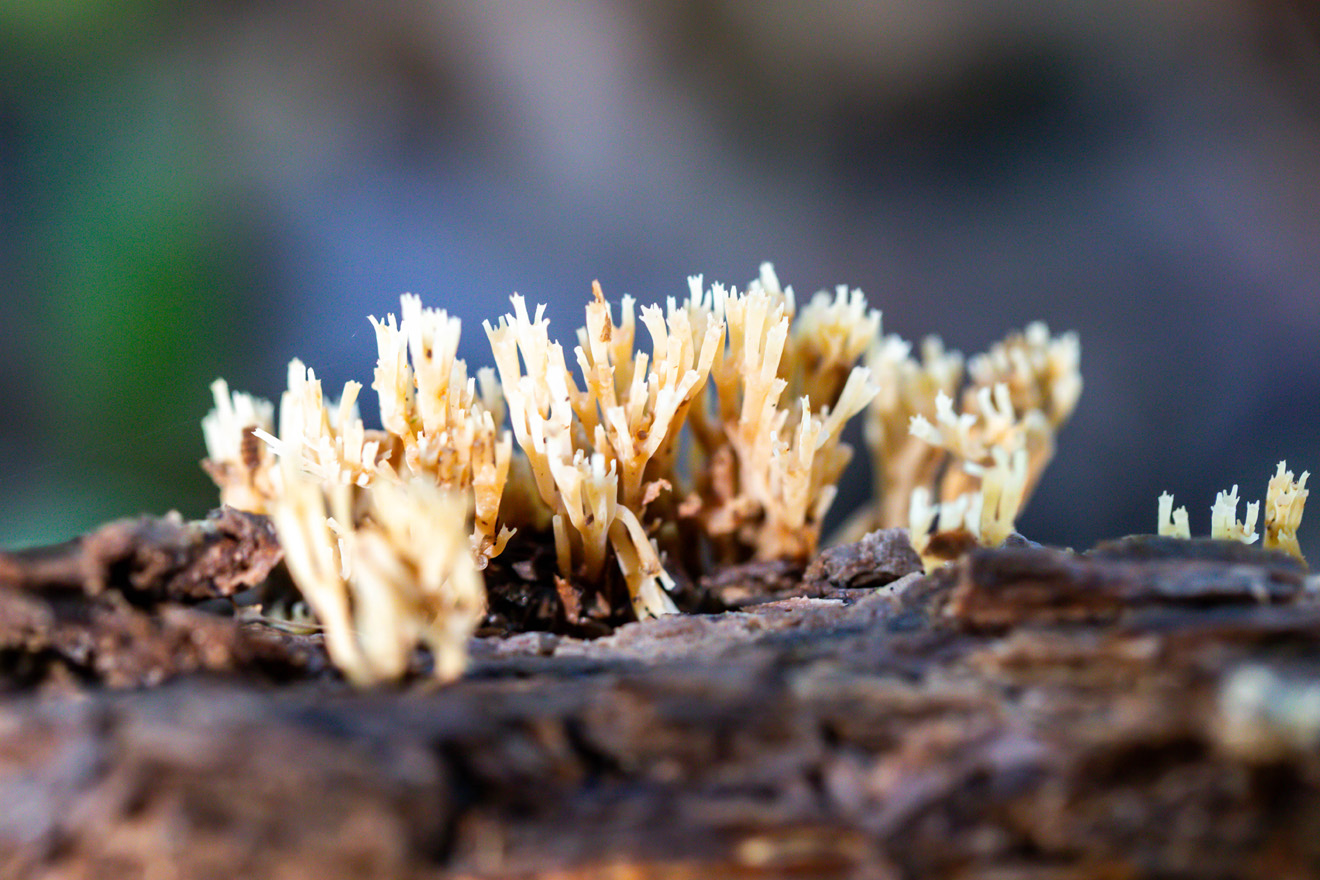
Further down the same log was a crown-tipped coral fungus (Artomyces pyxidatus), a branched club fungus whose tips feature a tiny cup surrounded by 3-6 spikes. This species always grows on wood as opposed to in the ground, distinguishing it from several look-alikes.
Moving a little further up the trail, we found a few fruiting bodies of artist’s bracket (Ganoderma lobatum). These mushrooms, and related ones in the same genus, get their name from the way their white pore surfaces bruise brown when etched. Once the mushroom dries, these etchings become permanent, turning them into a piece of artwork. (Here’s a fun example.)

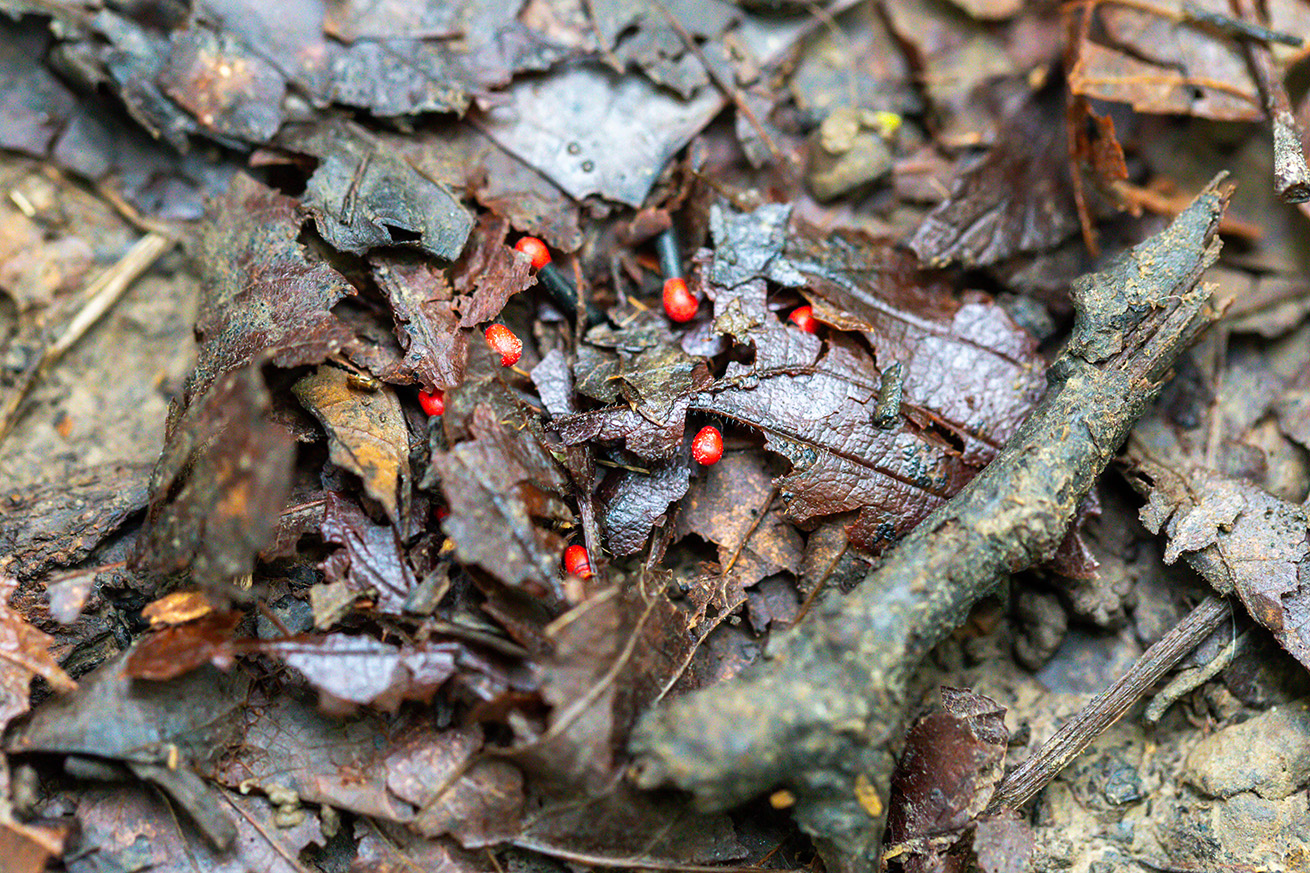
As we entered the back half of our walk, my eye caught a cluster of tiny red caps peeking out of a pile of wet leaves. As I leaned closer, I noticed they were on black stalks. What had we here?! Fields came in for a closer look, and we both marveled at this unusual color combination. Were they capped mushrooms that just hadn’t opened yet? Had we found something…dare we dream…new to science?
We dug in. Fields pulled up iNaturalist to see if she could get a suggestion, and I got down in the mud to make sure I was covering all the angles. iNat was stumped, so Fields started moving the leaves so we could get a fuller picture. It was only after five minutes and a full submersion of my knees in the mud that I realized: we were looking at a hairbrush. We had gotten really excited about something that had fallen out of someone’s purse.
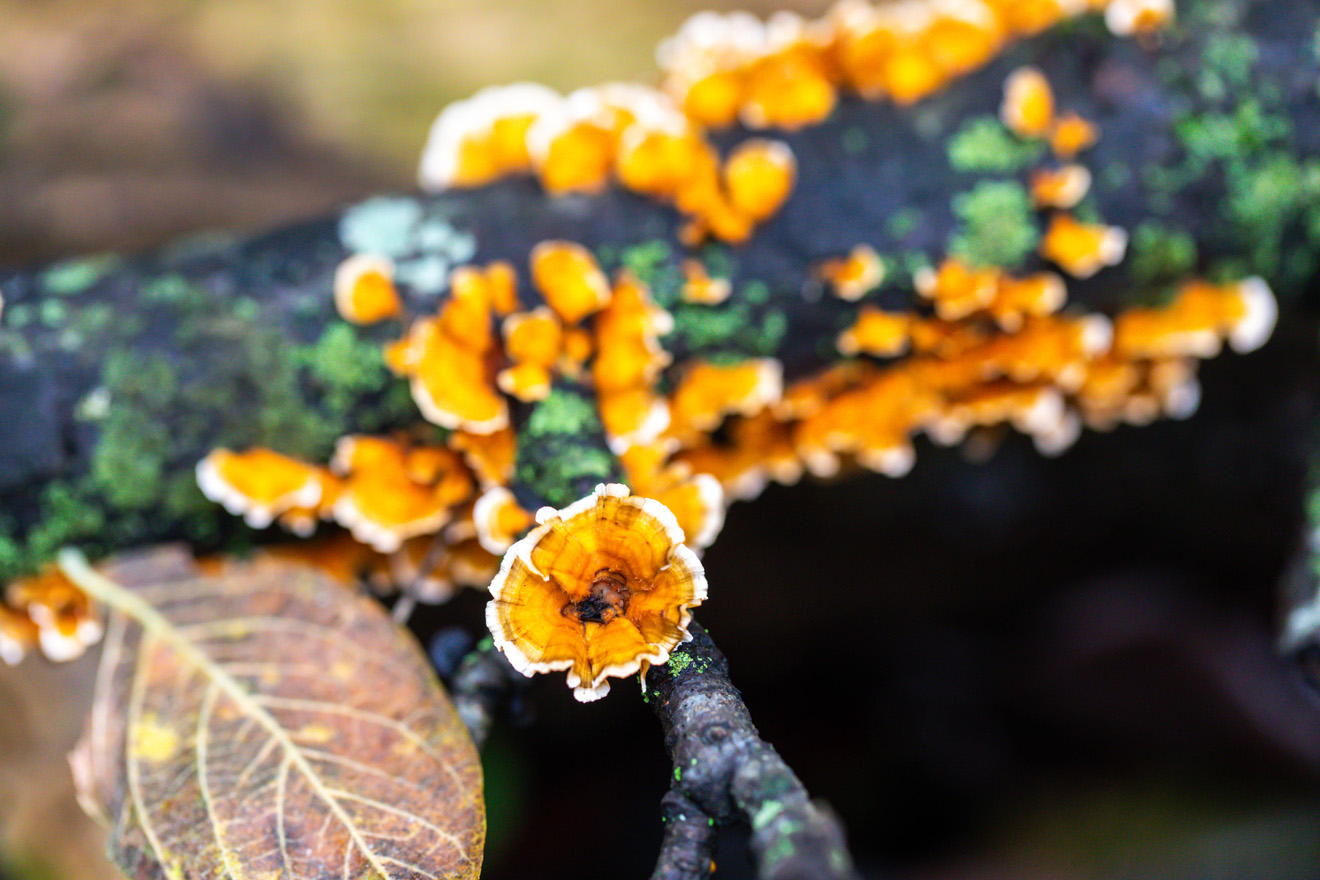
Well. There went our dignity and all our naturalist cred. Utterly chagrined, we continued on, feeling like we had been tricked by our own eager eyes. But as luck would have it, we soon stumbled on a treasure trove where a couple of large fallen branches were teeming with fungal life. There was our old friend crowded parchment (Stereum complicatum), one of my favorite pops of color in the winter.
One log was covered with violet-toothed polypore (Trichaptum biforme), whose fresh pore surfaces have a beautiful lilac tint. We usually see this fungus when it’s more aged and its colors have faded to brown; like the cobalt crust, we’d caught this one during the early part of its “bloom.”
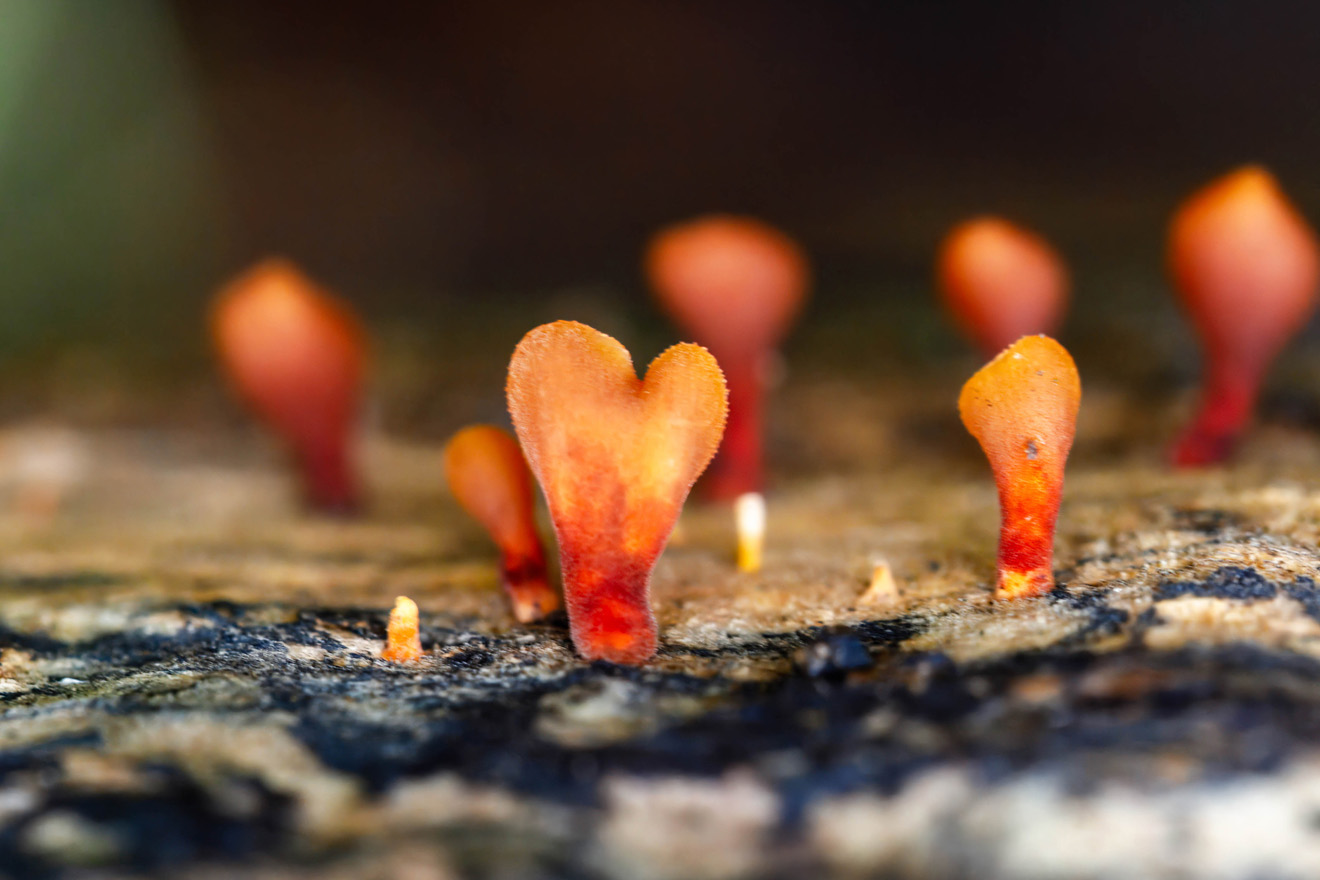
Looking like burning candles or bleeding hearts, Dacryopinax elegans was also just getting started. This is a jelly fungus that eventually grows into the shape of a concave dish that’s been stood up on its side.
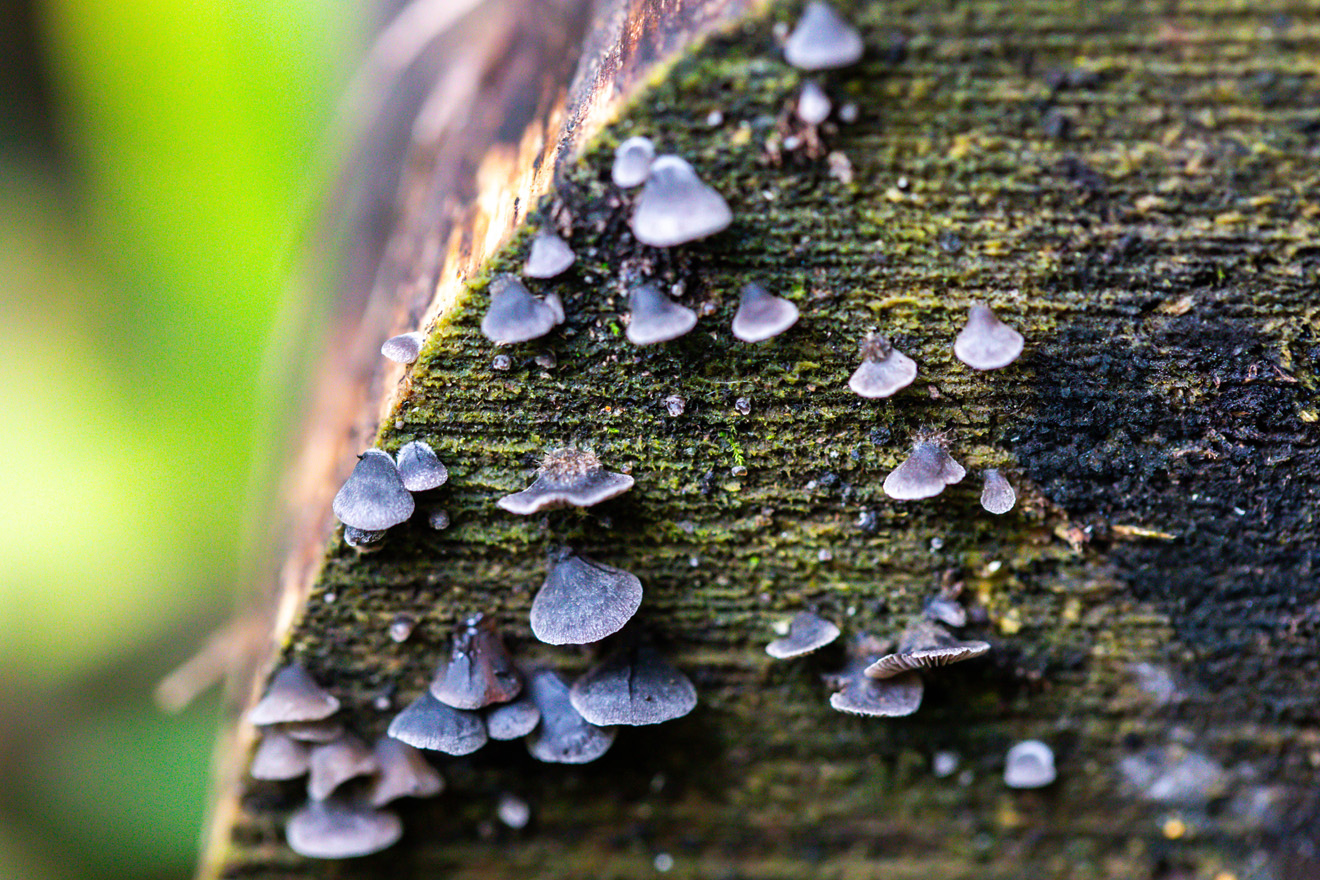
When a large tree falls across one of the walking trails the Conservancy manages, we cut out the portion that blocks the trail and leave the rest of the tree to decay in place (which gives these all fungi something to grow on!). These oysterling mushrooms (Resupinatus sp.) covered the side of one of those downed trees on the relatively smooth surface where we made the cut.
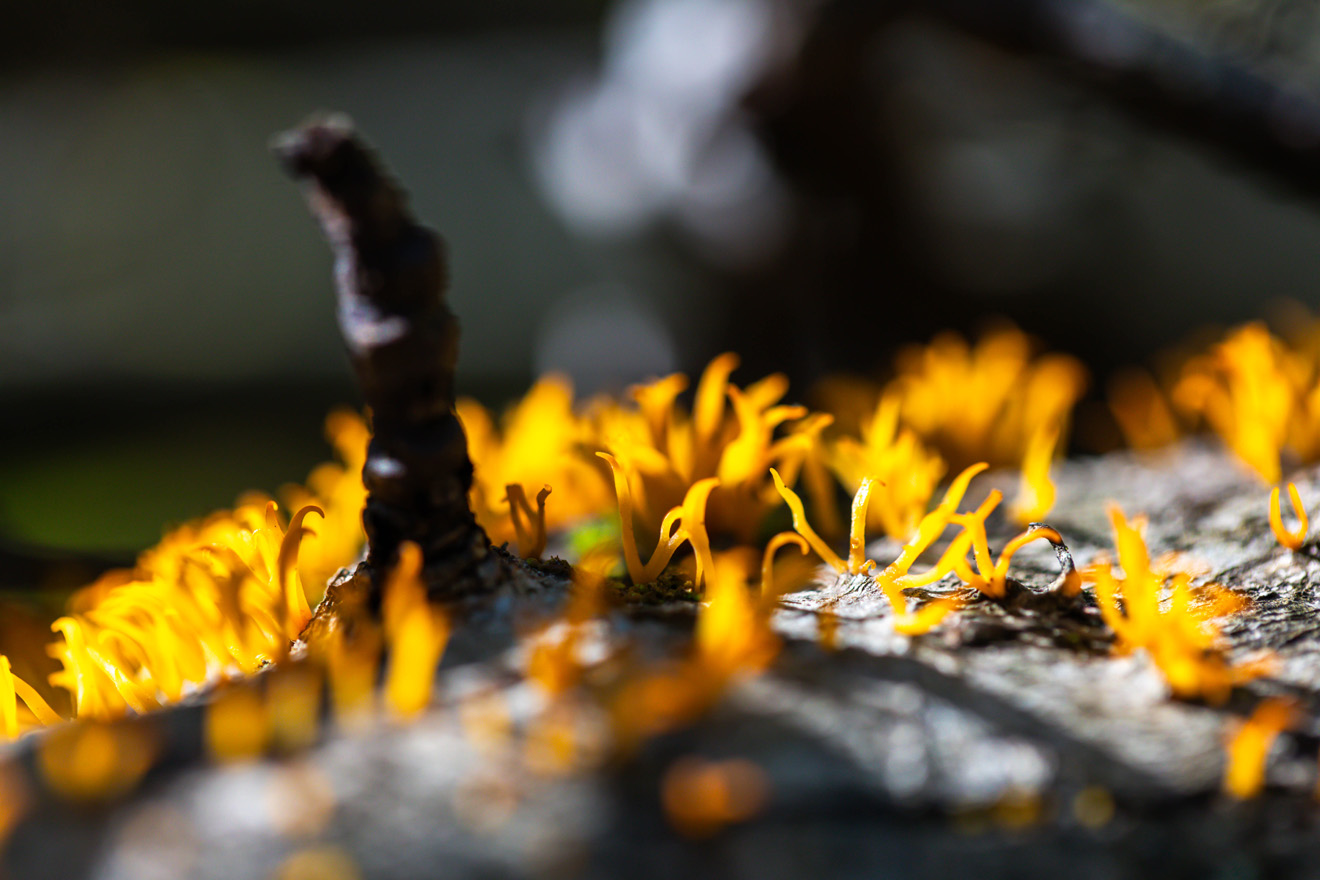
No, this one’s not a series of small flames–it’s club-like tuning fork (Calocera cornea). It looks like a club fungus, à la the crown-tipped coral fungus above, but is actually another jelly. The “tuning fork” name comes from the shape of their spore-producing structures (only visible under a microscope). These fungi especially love a dead oak, which makes the Old Forest a real paradise for them.
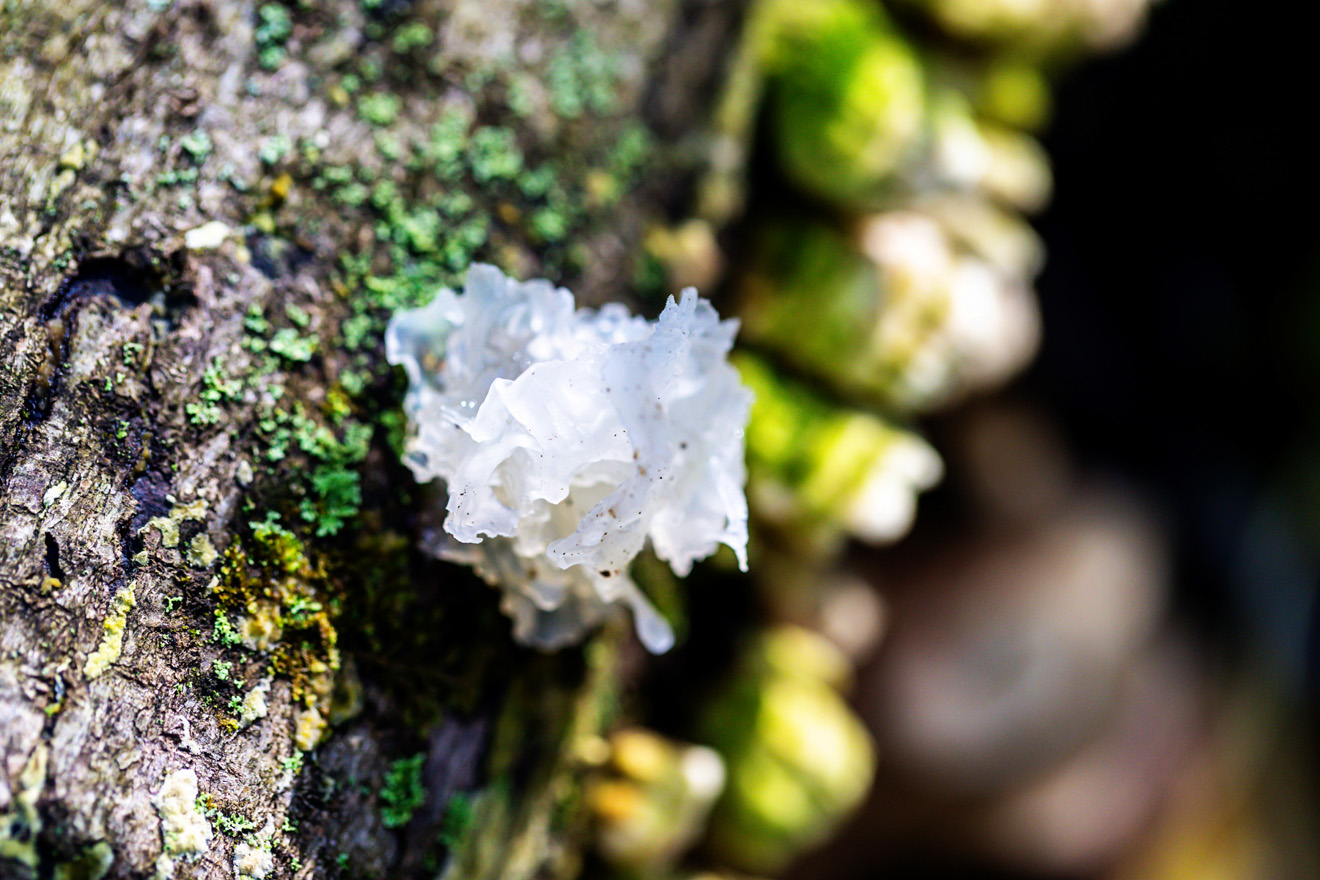
Next up was a translucent glob of snow fungus (Tremella fuciformis), another gelatinous mushroom that occurs alongside a charcoal-like fungus called Annulohypoxylon archeri (or as it’s more colloquially known, cramp balls). Whether snow fungus is parasitizing the cramp ball or is involved in a symbiotic relationship with it, it can’t create a fruiting body without the help of its charming partner. Snow fungus is a key ingredient in Asian cuisine and medicine, which means that both these species have to be cultivated to get to the delicious prize.
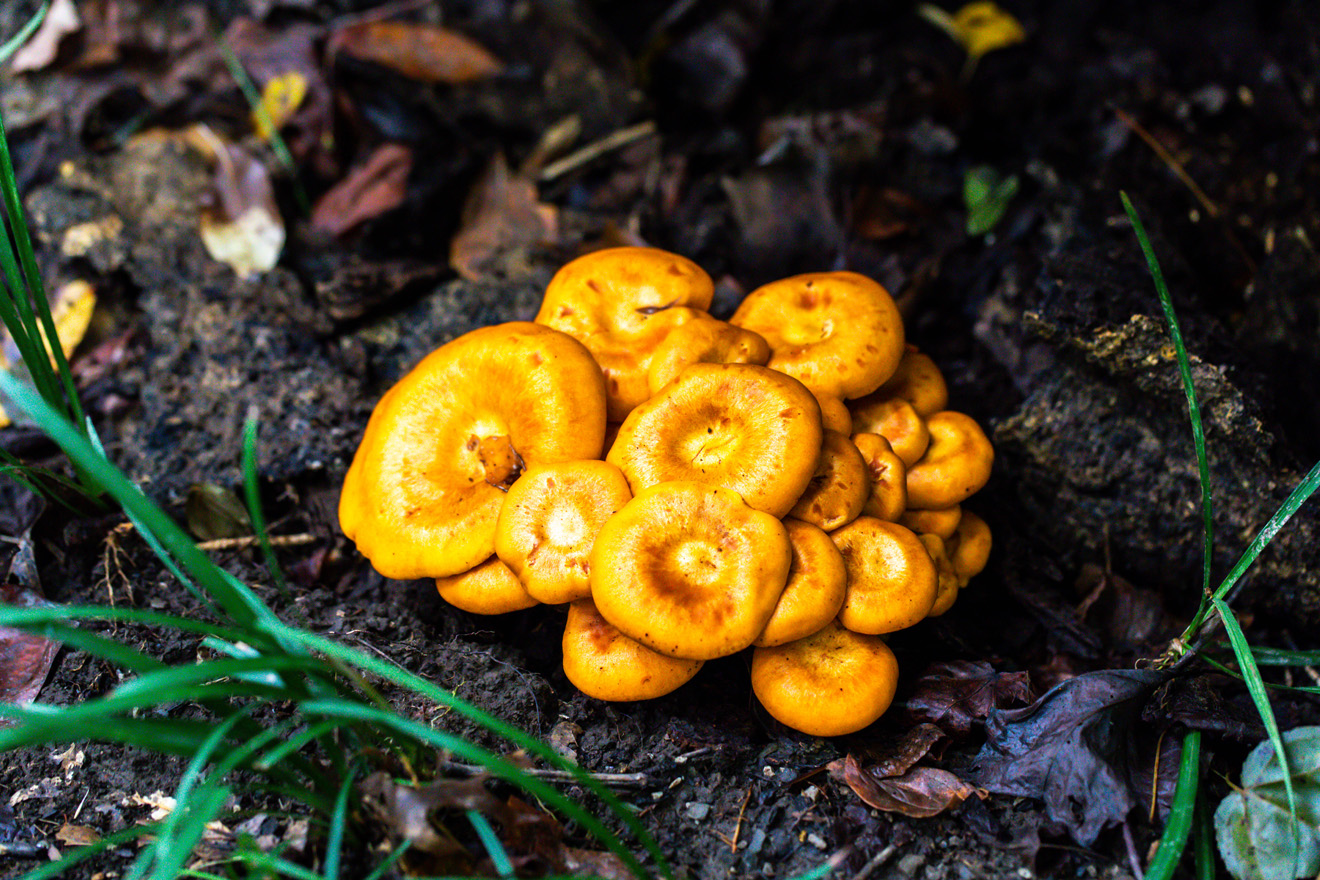
Finally, we knew we had to complete this expedition by looking for the Eastern American Jack-o-Lantern (Omphalotus illudens) that sometimes reveals itself this time of year. We went to its usual spot and found just one small cluster hiding underneath a formidable log. In the past, this mushroom has grown robustly beside a large tree, but that wasn’t the case this time. We guessed that maybe that big tree had turned into the fallen log when we weren’t looking, and this one little patch of mushrooms is hanging on. Despite its pumpkin-like appearance, this one is toxic to humans–but it’s sure fun to encounter it on the side of a trail!
With rain in the forecast this week, mushroom-spotting conditions should be good this weekend! As a reminder, the Old Forest is a Tennessee State Natural Area, and foraging is not allowed. In such a small forest that’s under constant stress from its city setting, taking any living things out has an outsize impact on the limited populations to be found here. Photography and vocal admiration is very much encouraged, though, and we’d love to hear about it if you’ve seen something cool!