Many of us might walk into a place like the Old Forest, look at the very tallest trees, and think “Wow, those must be so old.”
But just like with people, size doesn’t necessarily tell us a lot about age. To use some giants of Memphis as an example, Marc Gasol is much taller than Al Green, but Al Green has been around quite a bit longer. There are a lot of factors that contribute to a tree’s size: its species, the amount of light and water it received, and disturbances it experienced. To get an idea of a tree’s true age, we have to look at its rings by taking a small core sample of its trunk.
When Conservancy Director of Operations Eric Bridges began examining tree cores in the Old Forest with students from Rhodes College back in 2015, he found that the oldest class of trees dated to around 1835, making them about 190 years old today. But when former Rhodes College and current College of Idaho professor Dr. Robert Laport asked him to assist on a tree coring project, Eric got a surprise: a tulip poplar in Overton Park that appears to be over 220 years old.
True to the maxim that size is not a proxy for age, this tree (found on the Green Trail) was not among the largest examples of its species. The growth rings closest to its center are very close together, indicating slow growth in the tree’s early years. This is unusual for tulip poplars, which require a lot of sun to get started and thus typically grow quite rapidly. (“Did it have a rough childhood?” Eric wonders.) For a tulip poplar to grow that slowly and still stay alive, something other than shade must have been checking its growth.
This tree also has a hollow, dark spot toward the middle, which can sometimes indicate that the tree experienced fire, but another tree Eric cored at Meeman-Shelby State Forest that’s roughly the same age doesn’t show any evidence of fire disturbance. It’s more likely that the tulip poplar just has some rotting tissue on the inside, though it continues to grow.
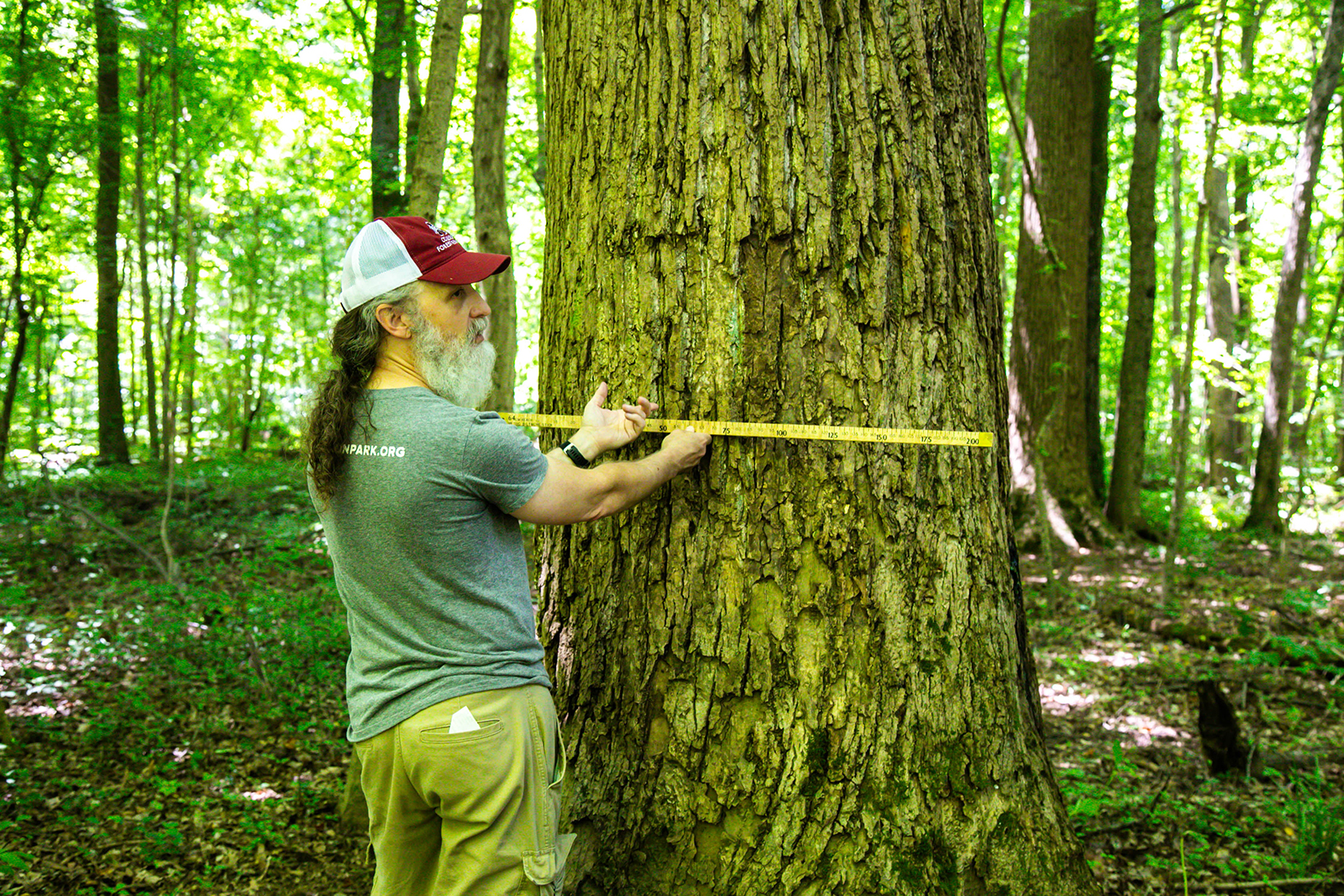
Eric uses a Biltmore stick to determine the diameter of a 225-year-old tulip poplar.
Dr. Laport’s research aims to categorize five Memphis-area urban forested natural areas according to how well they meet the standards for “old growth.” Eric took samples of 4-5 living trees from Overton Park, Meeman-Shelby, T.O. Fuller State Park, Nesbit Park, and the Lucius Burch State Natural Area, including oaks and tulip poplars from each site. Dr. Laport will conduct a thorough analysis incorporating each forest’s species composition and structural features (e.g., large trees, coarse woody debris, etc.) and estimate their ballpark ages from the sampled cores, but initial results show that Overton Park’s trees are the oldest. While Meeman-Shelby also had a 225-year old tree, its remaining sampled trees were much younger than Overton’s dominant age class of 190 years. Nesbit Park in Bartlett was only returned to a forested landscape in the 1900s, and its oldest trees are around 75 years old.
An old-growth forest typically meets five criteria: trees over 150 years old, dead trees left standing, pits and mounds created in the soil by old trees falling down, fallen trees left on the ground to decompose, and a relative lack of human disturbance. While it’s difficult for any urban forested natural area to meet the fifth standard, Overton Park does satisfy the first four. Since Overton Park comes the closest to meeting the old-growth standard, Dr. Laport will compare the other four parks to it as his research continues. He’ll dive deeper into the other categories, including conducting surveys of non-tree vegetation to see whether forests get more or less diverse as their trees age.
Coring trees often brings up more questions than it answers—why was our 225-year-old tulip poplar growing so slowly, but the 190-year-old trees were growing so fast? But the fact that a 4-millimeter piece of wood can offer a glimpse into 225 years of history is another reason that we’re excited to continue learning all we can about the mysteries of the Old Forest.
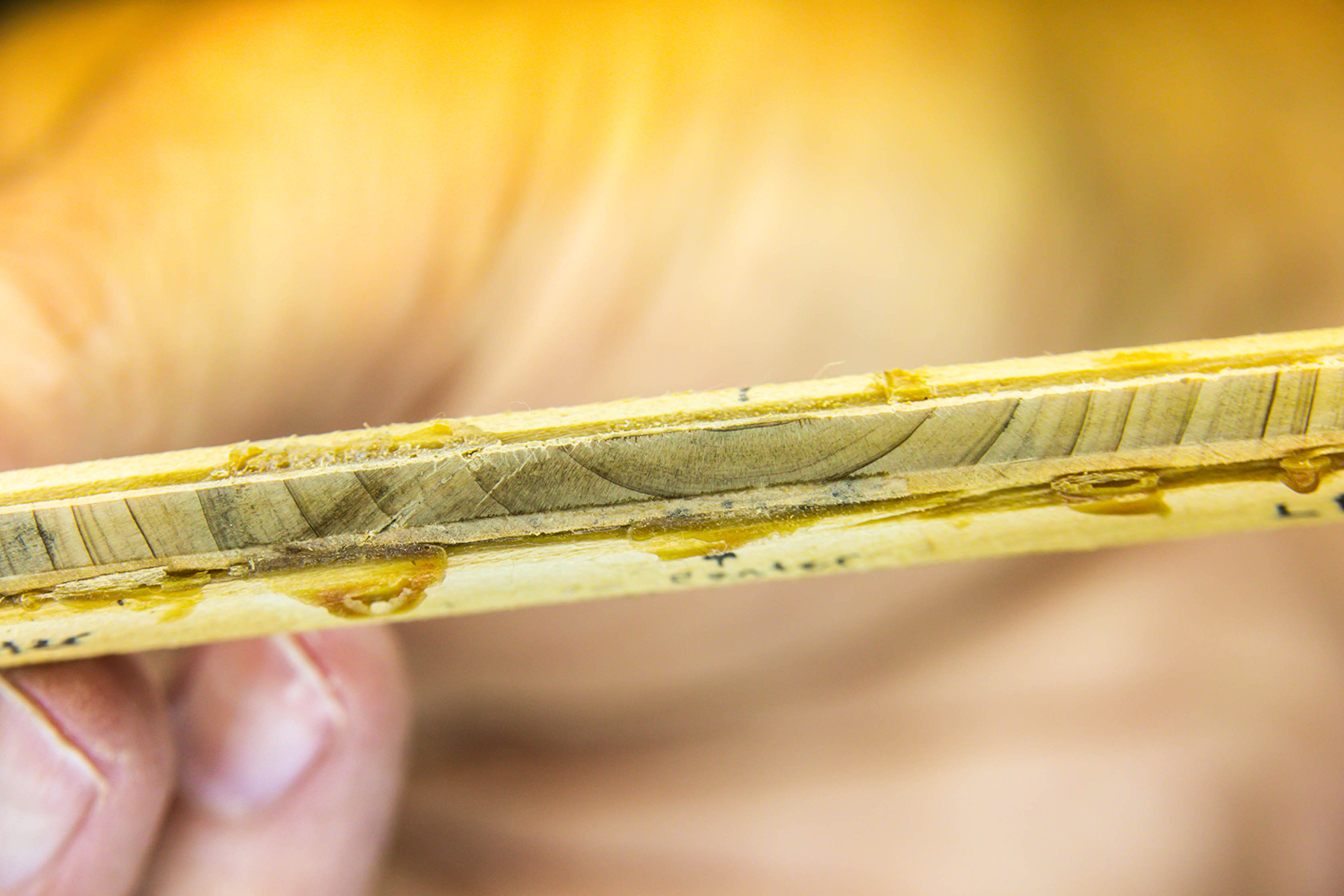
The core of a bald cypress tree sampled at Lucius Burch State Natural Area.